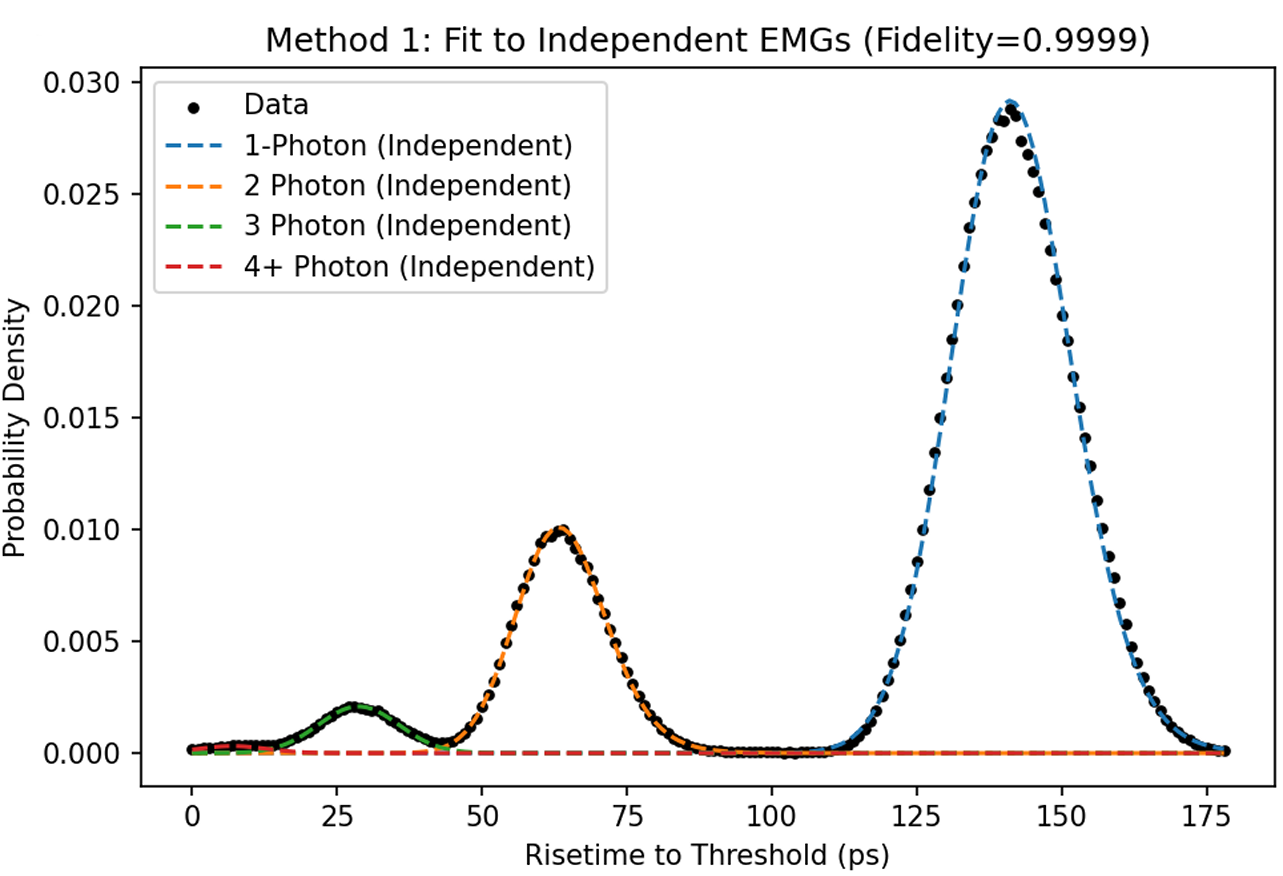
The ability to accurately determine the exact number of photons in an event, namely photon number resolution (PNR), is crucial for quantum networking, communication, and sensing. While pseudo-PNR approaches rely on multiplexing, true PNR depends on the ability of the detector and electronics to efficiently discriminate electrical signals under different count rates, optical, and electrical conditions. This work explores a fidelity and accuracy assessment and discrimination methods from peak separation PNR methods. The signals generated by Quantum Opus SNSPDs were acquired and analyzed with picosecond resolution via Swabian Instruments Time Taggers. Experimental data reveal the tradeoffs between photon-number distinguishability acquisition and processing methods. Both mathematical analysis methods (a Poisson-weighted or independent exponentially modified Gaussian) agree on the optimum threshold voltage, but vary in practical deployment, robustness against parameter degeneracy, and further capabilities. Both timing acquisition methods allow for PNR, but self-referenced rise-time measurement sacrifices some distinguishability for increased optical flexibility.